
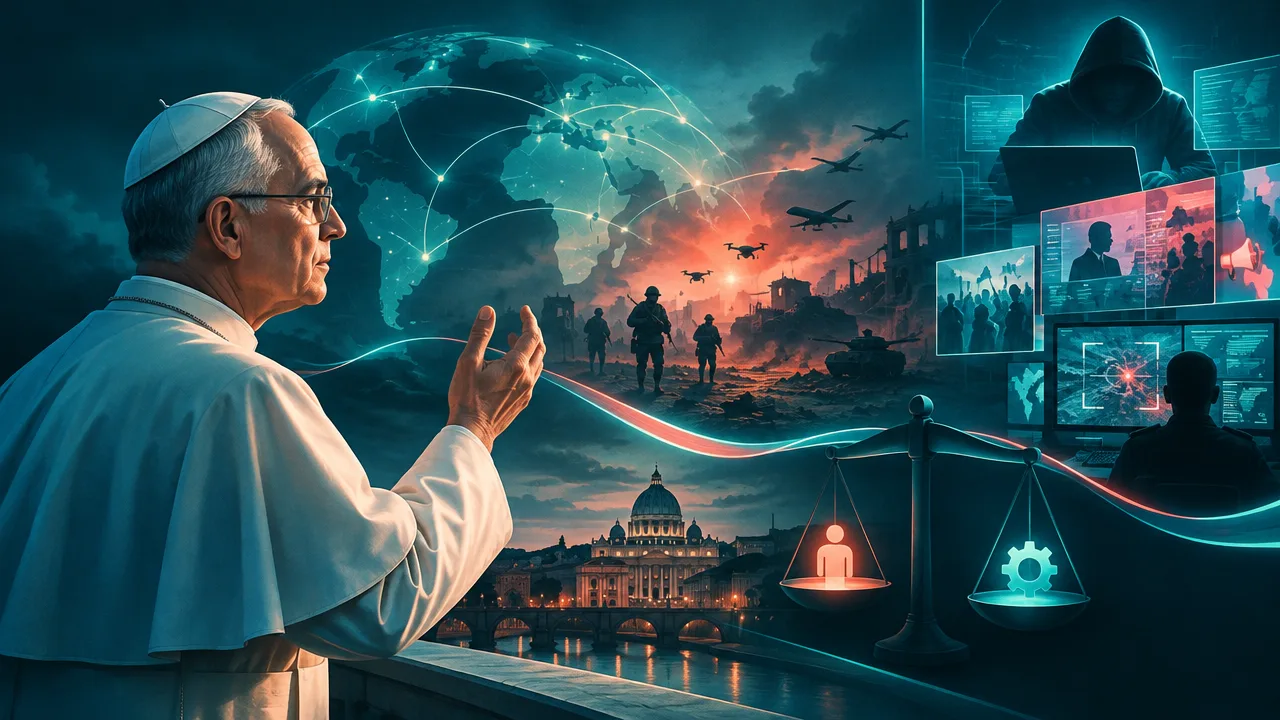
Wars are no longer fought only on the battlefield. Alongside armed conflicts, new forms of confrontation are emerging—less visible yet equally dangerous—that use technology to strike, influence, and condition. This is the framework highlighted by Pope Leo XIV, who calls for reflection on the relationship between artificial intelligence, innovation, and security.
In his speech, the Pontiff emphasises how the digital revolution is profoundly changing the way conflicts develop. Traditional military tools are now accompanied by cyberattacks, information manipulation, and influence campaigns capable of reaching people and institutions even at great distances.
Another aspect concerns the automation of strategic decisions. Increasingly advanced systems can be employed to manage defence operations and activities but can also be transformed into offensive tools. This distinction is becoming ever harder to identify, especially when the same technologies can be used both to protect and to attack.
The Pope also addresses the topic in his encyclical Magnifica Humanitas, dedicated to artificial intelligence and its impact on society. The aim is to draw attention not only to the opportunities offered by technology but also to the dangers that may arise from its misuse.
The challenge, therefore, concerns not only the development of new technologies but also the responsibility of those who design and use them. In a world where information can become a means of attack and decisions entrusted to machines carry increasing weight, it becomes essential to establish limits and rules.
Progress cannot be considered positive regardless: the difference lies in the way it is put at the service of humanity.
Sources and documents
Original article by Lucrezia Piscolla, inviata.