
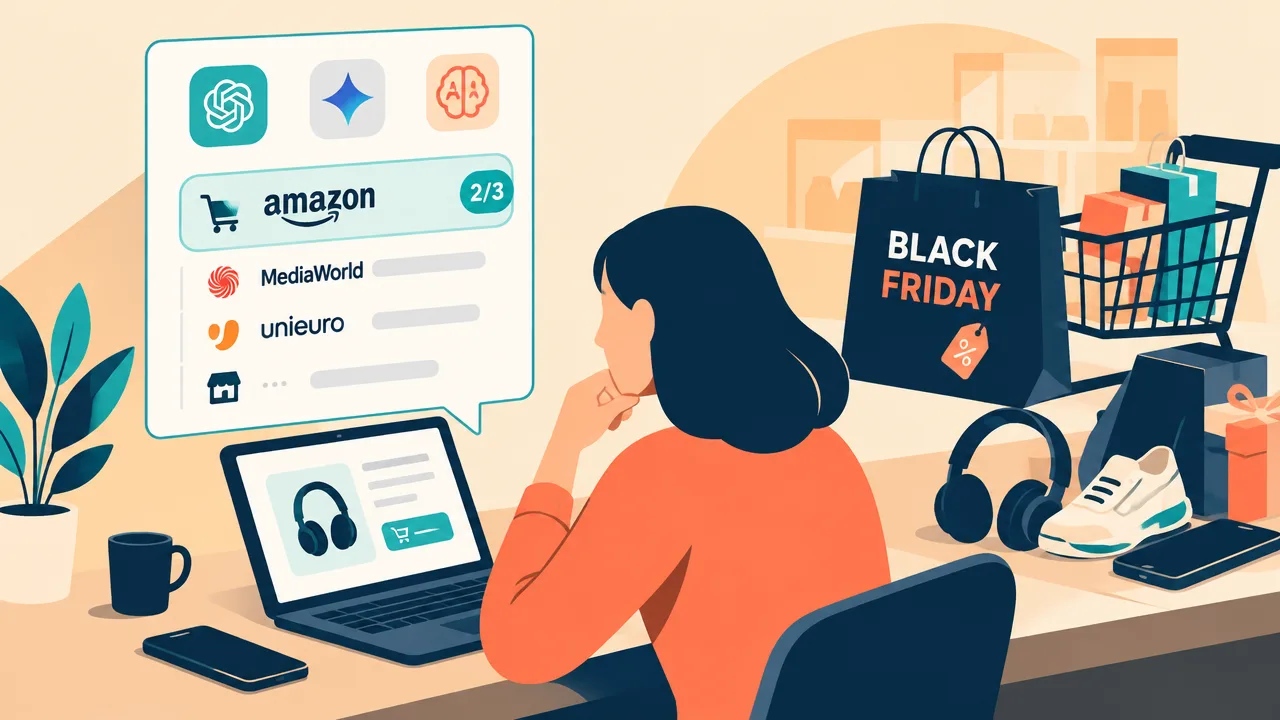
More and more Italians are asking an AI assistant where to find Black Friday deals, this year scheduled for Friday, 27 November. But who really decides what ends up in the shopping cart? A survey by the Netstrategy Observatory on Black Friday 2026 analysed 30 responses provided by ChatGPT, Gemini and Claude to 10 shopping questions.
they recommend Amazon 2 times out of 3
The result: Amazon appears 19 times out of 30 (63%), MediaWorld and Unieuro 16 times (53%), while 59 stores out of 91 (65%) are mentioned only once.
Amazon is the first store suggested in 15 of the 24 responses where the AIs indicate where to buy (62.5%). It appears in 8 out of 10 questions and is recommended by all three AIs. MediaWorld and Unieuro are mentioned in 16 responses each, in 6 out of 10 questions, by all three AIs.
Followed by Decathlon, Euronics, Sephora and Zalando with 6 responses each, and Douglas with 4. At 3 recommendations each are, among others, Adidas, Cisalfa, Dorelan, Dreame, Emma, Nike, Notino and Samsung.
The sample coded 194 recommendations and 91 unique stores. Only 12 stores are recommended by all three AIs. By type, the recommendations, again according to this survey, go to generalists for 45% (88), to manufacturer brands for 29% (56) and to vertical specialists for 26% (50).
But what do people buy? The dominance of the big retailers is particularly true for technology. For 55-inch TVs, the AIs point to 13 generalists, 2 manufacturer stores, and no specialists. Elsewhere, the picture changes:
Mattresses: 19 recommendations out of 21 (90%) go to specialists and manufacturer brands like Emma, Dorelan and Perdormire. Generalists are only 2.
Gifts under 50 euros: specialists (19 recommendations) exceed generalists (14).
Robot vacuum cleaners: 9 recommendations to generalists, 7 to manufacturers’ stores (Dreame, Roborock, Ecovacs, Eufy). Running shoes: 11 recommendations to generalists, 9 to specialists and 11 to manufacturers.
The AI that drives you to Amazon also advises you to beware of discounts. To questions about verifying discounts and online/store price comparison, none of the three AIs recommend stores. However, all encourage checking the lowest price in the past 30 days and using price history tools like Keepa, Idealo and Trovaprezzi. But who fuels the answers?
Among the links present in the responses, the most frequent domain is Topnegozi, a coupon aggregator (10 links), ahead of Idealo, Keepa and TuttoTech (4 each). Altroconsumo and the MIMIT website appear only once. This is descriptive data: the presence of a link does not prove that that page was actually used by the model to build the answer.
"We are facing a paradigm shift: the consumer no longer browses a showcase of links, but receives an already filtered answer," says Stefano Robbi, CEO of NetStrategy. "And the data from our Observatory shows that the answer has favourites."
In technology, Amazon, MediaWorld and Unieuro occupy almost all the available space: if you are not among the names that the AI knows and considers reliable, you simply do not exist in the cart." But there is also encouraging news: where the market is fragmented, from mattresses to gifts under 50 euros, the assistants make room for specialists and manufacturer brands.
This means that visibility in AI responses is not a privilege of the giants but is built with clear content, curated product sheets, reviews and presence on the sources that the models read. A sign of the times. Although, it must be said, some still go to shops, perhaps hand in hand, to choose gifts or make a surprise to their loved ones.
Sources and documents
Original article by Umberto Mancini, direttore editoriale.