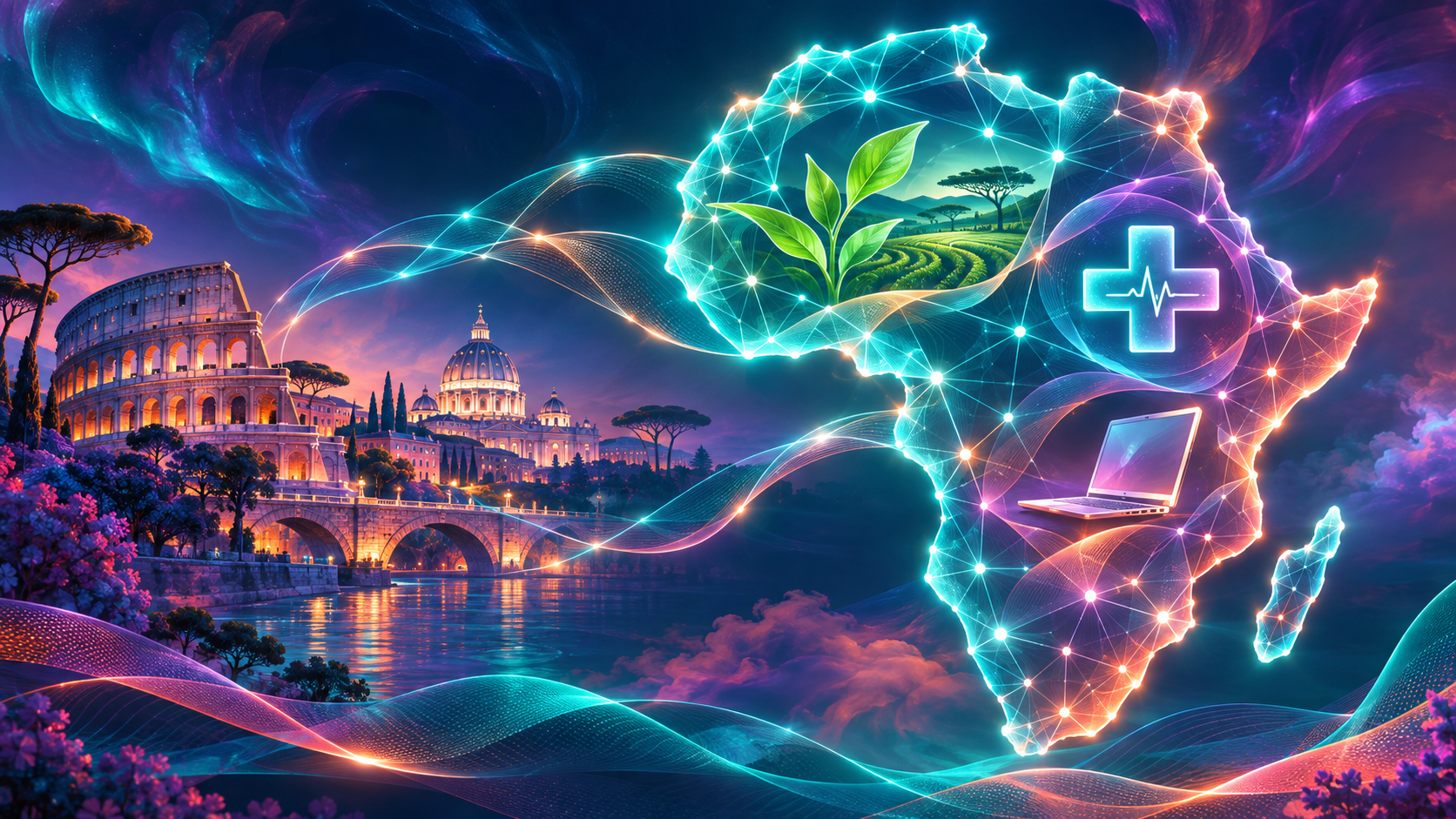
"Artificial intelligence is a technology moving fast, Africa is a continent growing fast, over 60% of its population is under 25, and this is therefore where two of the forces that will shape the future meet. Investing in Africa with artificial intelligence is the only way to accelerate the development of a continent still struggling with hunger and poverty. It means putting crop diagnostics into the hands of small farmers, bringing healthcare services where there is no connectivity, bringing knowledge to those currently excluded from it, and giving young Africans the tools to create businesses and jobs. I believe it is important and significant that this AI hub was established in Rome, which already hosts the United Nations programmes for food and the United Nations programmes for developing countries, and therefore for Africa. But technology, as we all know, is not enough on its own. Collaboration makes the difference, cooperation between those who can help and those who need help. When a country shares the expertise built over decades, the infrastructure it has invested in and the results it has already achieved, it allows others to avoid starting from scratch. Entire stages and technological phases can be skipped, as already happened in Africa with mobile telephony and digital payments, which spread even before fixed networks and bank branches. With artificial intelligence that leap can be even greater, more significant. Sharing what we know how to do means shortening by years the journey of developing countries towards their goals, which are shared goals.
The Mattei Plan, strongly championed by Giorgia Meloni, was created precisely for this purpose: cooperation between equals, built together with African partners. Naming the plan after Enrico Mattei also points to the path Italy wants to follow with its European partners. And the results are already visible. The plan now includes 76 projects in 18 partner countries.
With this AI hub, established during Italy’s G7 presidency and led by our ministry, the Ministry of Enterprises and Made in Italy, together with the United Nations Development Programme, we have involved over 1,100 African innovators and more than 150 Italian organisations, while over 7,000 startups have registered on the hub’s platform. When we conceived it during our G7, at the summit we held in Verona and then in Trento, we did not think it would become a reality so quickly and already deliver its first results.
Cineca has made 1.5 million computing hours on the Leonardo supercomputer available to train models in African languages. With Cyber for Africa we support 49 startups from 13 countries in cybersecurity. And with India and Kenya we have launched a trilateral partnership on voice-based artificial intelligence for agriculture, healthcare and public services.
Behind these already significant figures are concrete results. Thanks to Italian supercomputing, the voice models of a Ugandan startup now work offline in the country’s healthcare facilities, serving hundreds of community workers. An Ethiopian startup has raised the accuracy of speech recognition in Amharic from 93 to 96%, the threshold needed to work with banks and national broadcasters. A Moroccan startup, together with Fondazione Mach and Piedmont’s agricultural sector, has developed a digital agronomist that can reach over 3 million farmers. And an Italian company, Domine, is bringing its language models to 14 African countries with Microsoft.
These are concrete examples with objectives already achieved. It is a journey in which, of course, our research centres have found new partners and new fields of application. Collaboration is not merely a gift: above all, it is a shared investment that generates value for both sides, an economic and technological bridge, a bridge facing the challenges of the future between our continent, Europe, the G7 that promoted this AI hub, and of course the countries on the southern shore of the Mediterranean and the African continent".
Sources and documents
Document date or reference period: Speech at Luiss University in Rome · text supplied by the author.
Contribution by Umberto Mancini. The speech is published in full as supplied by the author; bold emphasis was added by the editors.