
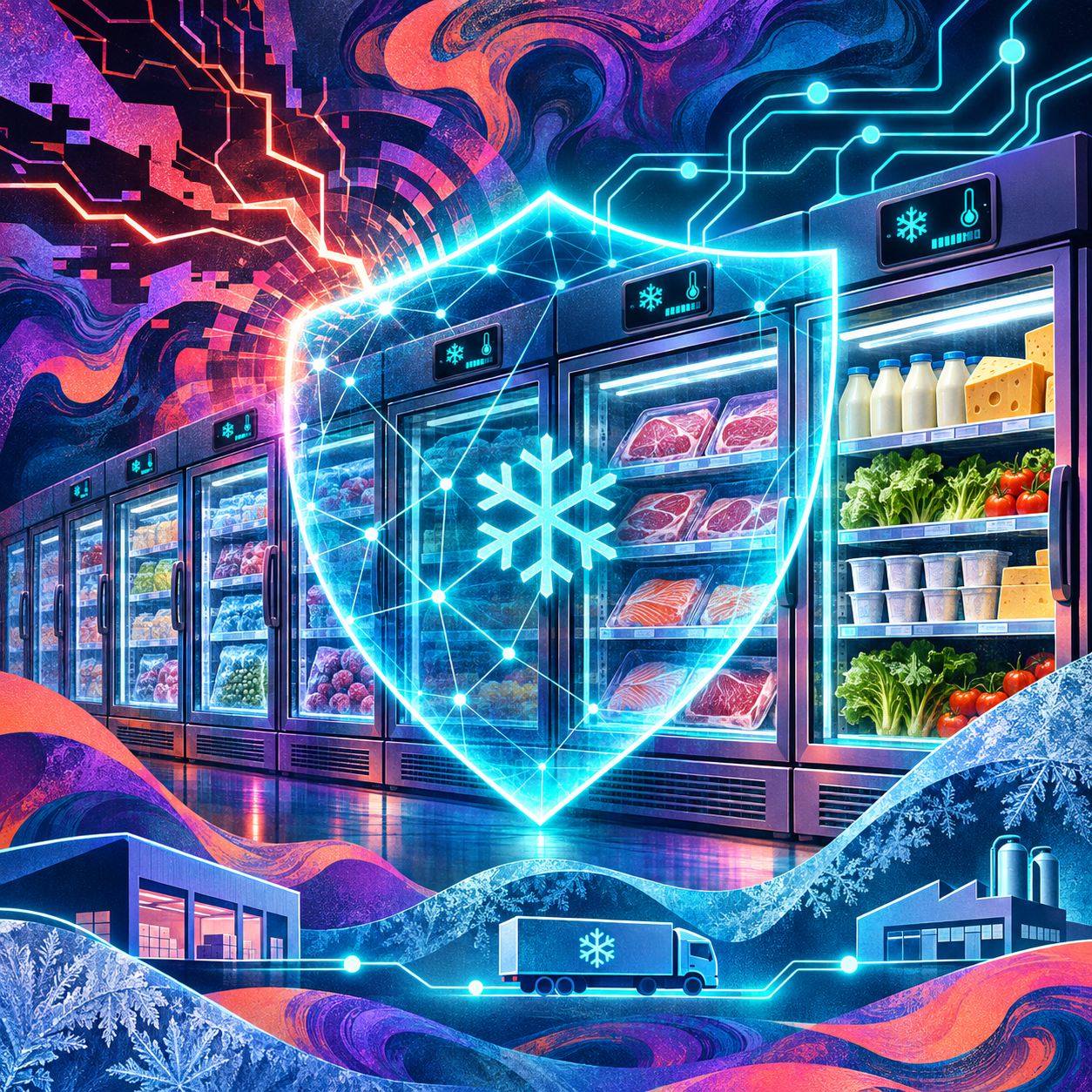
The wave of cyberattacks that recently disrupted the refrigeration systems of hundreds of supermarkets in France has also reached other European countries and Italy. This time, the hackers were not targeting credit card data or corporate accounts, but the "electronic brains" that regulate the temperatures of refrigerated display cabinets. Faced with this threat, which dangerously links the digital and physical worlds, the Italian Government and the National Cybersecurity Agency (ACN) acted promptly to reassure citizens, set out defence measures and secure the food supply chain.
The Government's response: no health alarm
During an emergency summit held at Palazzo Chigi on 3 November, Undersecretary to the Presidency of the Council Alfredo Mantovano, Minister of Agriculture Francesco Lollobrigida and intelligence leaders reviewed the situation. The institutional message is clear: there is no reason to panic. The impact in Italy was extremely limited, affecting only a handful of retail outlets in Sicily.
Why? The hackers had an easy time only where security systems were obsolete or seriously inadequate. The vast majority of Italy's large retailers withstood the attack thanks to up-to-date protective networks. Furthermore, to provide maximum protection for consumer health, ACN activated a direct channel with the Carabinieri NAS units: any temperature anomaly, however small, is immediately reported to prevent the sale of improperly stored or partially thawed food. The Government confirmed that it would maintain continuous monitoring in close contact with the entire food supply chain.
ACN's warning: too many "open doors" on the Internet
But how did the hackers manage it? A bulletin issued by CSIRT Italia (ACN's operational team), urgently recirculated as attacks occurred on Italian soil, explains the details.
IT experts explained that the attackers did not use techniques from spy films, but simply exploited serious failures in basic precautions. Many refrigeration systems were connected directly to the Internet without filters, often protected only by very simple factory passwords that installers had never changed. Once inside the system, the attackers could force defrost cycles or alter temperatures, causing products to spoil.
The golden rules for protecting the cold chain
To prevent similar incidents from recurring or being copied by cybervandals looking for easy publicity, ACN set out a veritable digital "first aid" plan for supermarkets and logistics companies:
• Disconnect from the public web: Refrigerator controllers and industrial systems must never be freely accessible from the Internet.
• Change the digital locks: Default passwords must be replaced and "two-factor authentication" systems (like those used by banks) adopted for maintenance personnel accessing remotely.
• Separate the networks: Administrative office computers must not be on the same IT network that regulates refrigerator temperatures. If an employee clicks on a malicious email, the virus must not be able to reach the refrigerated cabinets.
• Review old equipment: Devices too old to receive security updates (so-called "End of Life" devices) should be isolated and replaced as soon as possible.
• Manual emergency plans: Always have a "Plan B" to save goods if the IT system completely shuts down.
The shadow of psychological warfare: the objective is fear
Finally, there is a far more disturbing aspect that concerns intelligence services at this sensitive time of international geopolitical tension: the psychological and cognitive dimension of these attacks. Targeting the cold chain of large retailers is not just an act of economic sabotage. It is a carefully planned "hybrid warfare" operation designed to undermine citizens' confidence in the resilience of national security.
If a country appears unable to protect even basic necessities and everyday food safety, citizens suddenly feel vulnerable. The ultimate objective of those orchestrating or encouraging these incursions, exploiting network weaknesses, is not simply to switch off a refrigerator, but to ignite insecurity, sowing doubt that the infrastructure underpinning our lives is at anyone's mercy. Today, securing supermarket IT networks does more than save the shopping: it means protecting the emotional and social stability of the entire nation.
Sources and documents
Document date or reference period: Original contribution supplied to the newsroom · 3 November 2026.
Original contribution by Gerardo Costabile supplied to the newsroom, published with editorial formatting only. Analysis and assessments are the author’s.